Category: ATM

Project SKYLINE: A Mission Control Center for Scalable Drone Operations

One remote pilot, one drone—this model reaches its limits as soon as unmanned aviation is to be used on a large scale. In the SKYLINE collaborative project, we are therefore developing a mission control center for automated and autonomous systems: Unlike a traditional control center, it enables the simultaneous monitoring of multiple drones as well as the planning and adjustment of missions in real time. In this way, SKYLINE addresses a key prerequisite for scalable drone operations—from advanced air mobility to logistics and agriculture.

From a technical standpoint, the focus is on three key components: a standardized interface between ROS2 and ArduPilot for easily connecting different types of drones; end-to-end encrypted communication between the aircraft and the control center; and a dedicated radio link between the Digital Hub Industry at the University of Bremen and the Oldenburg-Hatten Airport (EDWH). This allows drones to be controlled from the control center while missions take place in geographically remote locations. An agricultural scenario involving field surveying with a thermal camera serves as a demonstration use case. The system architecture is designed from the outset to be expandable to include ground- and water-based systems.

Our role: the aviation regulatory classification of operations via a mission control center; standardized operational and emergency procedures for the simultaneous operation of multiple UAS; the establishment of the radio link; and test flights and approval submissions at the Hatten-UAS German Flight Center. The results will be directly incorporated into the service portfolio of our UAS control center in Bremen: Through standardized procedures and a Remote Control Center, the barrier to market entry will be lowered in the future for anyone wishing to use mission control as a service. Together with our partner TOPAS, we are developing this into a “test-before-invest” offering for regional companies.

SKYLINE (Duration: 2026–2027) is funded by the State of Bremen through the BAB – Bremer Aufbau-Bank. The project partner is TOPAS Industriemathematik Innovation gGmbH.

You can find more information on our project page: https://brm.de/projekt-skyline/

U-Space Architectures for Military BVLOS Drone Swarms

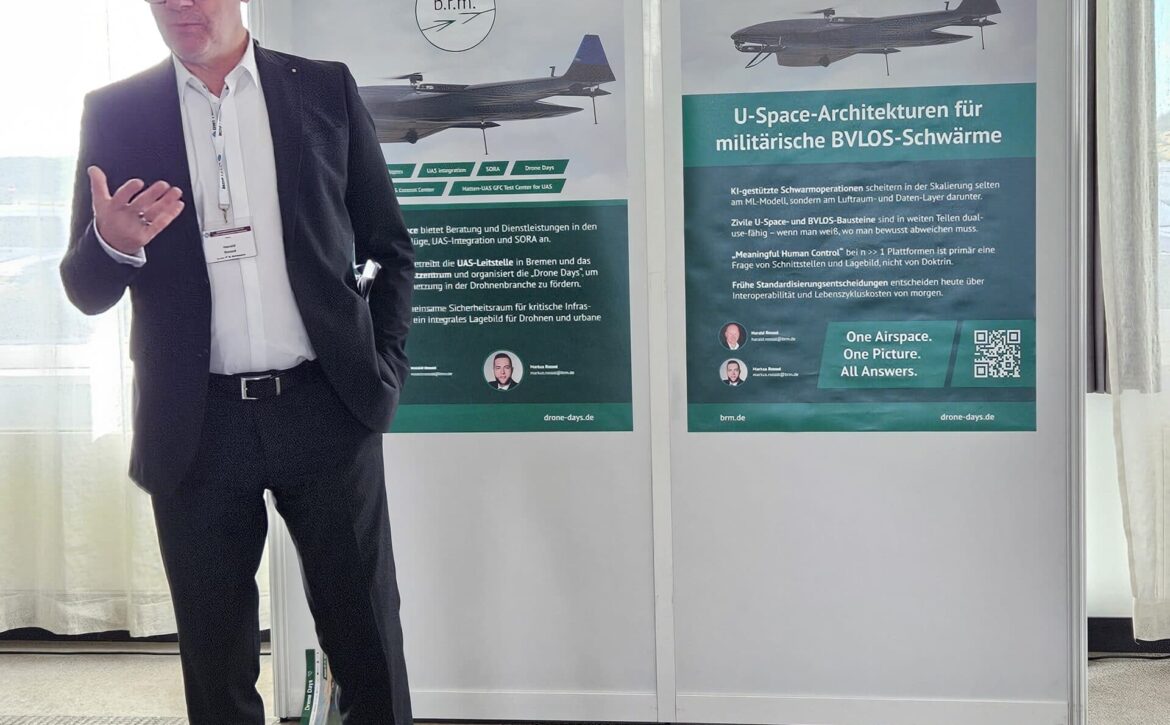
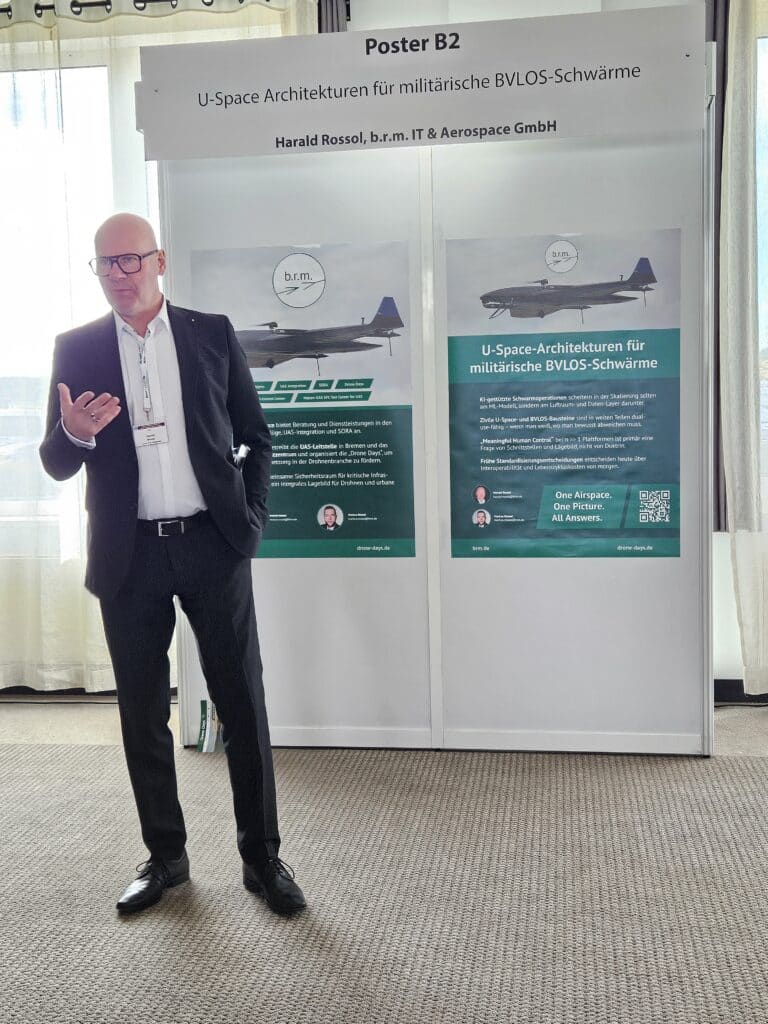
From September 21 to 23, the German Society for Defense Technology focused entirely on artificial intelligence and unmanned systems. Our CEO, Harald Rossol, delivered a clear message: The architecture for military BVLOS drone swarms already exists—in civilian applications.

Unmanned systems are rapidly transforming the security and defense landscape. In particular, the use of drones beyond the pilot’s line of sight (BVLOS, Beyond Visual Line of Sight) and coordinated swarm flight place high demands on airspace management, data integration, and situational awareness. This was precisely the focus of the presentation “U-Space Architectures for Military BVLOS Swarms”—first as a short presentation in the plenary session, followed by four sessions at the poster station.

Four Principles for Scalable Swarm Operations

The discussion about AI in unmanned systems often centers on algorithms and machine learning models. Harald Rossol deliberately shifted the focus to the level below that and put forward four propositions for discussion:

Scaling rarely fails because of the model. When scaling up, AI-supported swarm operations typically do not reach the limits of the ML model, but rather those of the airspace and data layers on which they are based.

Civilian components are largely suitable for dual use. Many components from U-Space and BVLOS operations can also be used for military purposes. The key is to know exactly where one must consciously deviate from standard practice.

Meaningful human control is a matter of interfaces. When a person is responsible not for one but for many platforms at the same time, effective human control depends above all on good interfaces and a reliable situational picture—and less on doctrine.

Standardization today determines the costs of tomorrow. Early decisions about standards determine how interoperable systems will be later on and what their lifecycle costs will be.

Not a vision of the future, but a reality in practice

The second thesis was deliberately worded cautiously when it was submitted in the spring. After ten years of operational experience, the assessment today goes further: What is needed for military swarm operations does not have to be reinvented. The architecture already exists in the civilian sector and is in operation.

The foundation is provided by the Hatten-UAS German Flight Center at the Oldenburg-Hatten airfield, which is operated by b.r.m. BVLOS flights have been tested there since 2016; EUROCONTROL manages the site as a test and evaluation area—alongside the DLR. An airspace of approximately 3,600 square kilometers is available for unmanned aircraft systems, extending from the airfield out into the German Bight.

Another component is the Bremen UAS Control Center, which, as a prospective U-Space service provider, is currently in test operation. It provides U-Space services in accordance with EU Implementing Regulation 2021/664, the European legal framework for the safe integration of drones into airspace. This ensures that the infrastructure is compatible not only technically but also from a regulatory standpoint.

Light Field and Dark Field in the Digital Twin

The concept of a shared situational picture generated particular interest. Through data and sensor fusion in a digital twin, both the “known” and “unknown” areas become visible: not only cooperative aircraft that actively transmit their positions, but also non-cooperative objects that can be detected solely through sensors.

The point behind this is simple: Only those who know who is flying legally can identify those who are not. The “dark field” is not a new development here, but rather a follow-up question—existing sensor data can be incorporated into the digital twin via sensor fusion and compared against the “light field.”

What's Still Missing on the Military Front

Two factors distinguish civilian architecture from military applications.

First, ruggedized sensors and hardware. This is where specialized manufacturers excel—the purpose of an open architecture is to allow any ruggedized sensor to be integrated without having to rebuild the system.

Second, a certification framework for adaptive software. Civilian certification locks in the configuration: tested, approved, unchanged. In military applications, software updates are needed in the field. The digital twin carries this verification with it—the same code runs first in a simulation, then in a shadow environment against real telemetry, and finally on board. It isn’t rewritten, but rather executed in a different location.

One Airspace. One Picture. All Answers.

Harald Rossol summarized his presentation in a guiding principle: One Airspace. One Picture. All Answers. A shared airspace, a unified situational picture—and thus the answers that operators, authorities, and the armed forces alike need.

The DWT conference demonstrated just how great the interest is in solutions that have been proven in practice. We are pleased with the many discussions that took place at the event and look forward to continuing our dialogue with partners from the Bundeswehr, industry, and research—for example, at our Drone Days.

About b.r.m. IT & Aerospace

b.r.m. IT & Aerospace offers consulting and services related to BVLOS flights, UAS integration, and SORA. The company operates the Bremen UAS Control Center and the Hatten UAS German Flight Center, and organizes Drone Days to promote innovation and networking in the drone industry.

b.r.m. IT & Aerospace GmbH

Harald Rossol

harald.rossol@brm.de

+49 421 341494

b.r.m. IT & Aerospace at ILA 2026 in Berlin

Next week is the big event: From June 10 to 14, 2026, the ILA Berlin will take place—the world’s oldest aerospace trade fair and one of the most important industry platforms in Europe. Around 750 exhibitors from 37 countries will present the full spectrum of the aerospace industry at the Berlin ExpoCenter Airport in Schönefeld—ranging from civil aviation to space technology and defense to the supply industry. 

b.r.m. IT & Aerospace will be on site at the North German Chalet (Chalets East | 22–24). Together with the other exhibitors, we will be representing the State of Bremen at the joint booth. Our topics at the ILA: our concrete proposal for a U-Space for the Bremen-Bremerhaven-Helgoland corridor, our work as a future U-Space Service Provider (USSP), the Advanced Air Mobility Initiative for Northern Germany and the German Bight, as well as Drone Days 2026, which will take place in August at Bremen Airport and Oldenburg-Hatten Airfield.

For us, the ILA is one of the most important platforms for engaging with government agencies, aviation authorities, and the industry. At AERO in Friedrichshafen, we were able to present our U-Space proposal to an industry audience—and at the ILA, we are continuing these discussions at both the national and international levels.

We look forward to exhibiting at the Bremen joint booth alongside our strong partners:

  • AES Aircraft Elektro/Elektronik System GmbH is an internationally established supplier to the aviation industry and has been developing and manufacturing electrical and electronic products for aircraft cabins for 20 years.
  • Esploro specializes in the management and support of national and EU-funded research projects in the aviation sector and oversees projects with a total funding volume of over 300 million euros.
  • Hanseatische Waren Handelsgesellschaft offers custom-made titanium products for the aerospace industry and has operated its own smelter for special alloys since 2021.
  • TRIGO Qualitaire GmbH is a multinational provider of operational quality management services with more than 10,000 professionals in 25 countries, serving clients in the aviation and defense industries, among others.
  • The DLR's Virtual Product House at ECOMAT in Bremen is driving forward digital aircraft development and working on the virtual certification of aircraft components.

Would you like to meet us at the ILA in the North German Chalet (Chalets East | 22–24)? We look forward to hearing from you—either by email or by phone (contact Harald Rossol or Markus Rossol).

b.r.m. IT & Aerospace at XPONENTIAL 2026 in Detroit

From May 11 to 14, 2026, Harald Rossol and Marius Ammermann will be attending XPONENTIAL 2026 in Detroit—the world’s largest trade show for unmanned systems and robotics.

b.r.m. IT & Aerospace will be exhibiting at the German Pavilion in Hall B–D, Booth 26013-4.

The German Pavilion is the joint booth for German exhibitors at XPONENTIAL and is organized as part of the Federal Ministry for Economic Affairs and Energy’s (BMWE) international trade fair program. This year, 14 German companies and institutions are represented at the joint booth—including b.r.m. IT & Aerospace, Beagle Systems, Germandrones, HHLA Sky, and Germany Trade & Invest, among others.

Our key areas of focus: unmanned systems (UMS), autonomous platforms, sensor technology, and control systems.

XPONENTIAL is the world’s largest event dedicated to unmanned systems and robotics, bringing together the international UAS community—manufacturers, operators, government agencies, and research institutions—every year. This year, the event is being held jointly with the Michigan Defense Expo (MDEX) for the first time. This underscores the growing importance of autonomous systems in the defense sector. For us, it is an important platform for expanding our international network, gaining first-hand insight into current developments, and positioning b.r.m. IT & Aerospace as a future U-Space service provider in an international context.

For more information about the trade show, visit xponential.org, and learn more about our presence at the German Pavilion.

Drone Days will take place August 26–28, 2026, at Bremen Airport and Oldenburg-Hatten Airfield. Register now as an exhibitor. For more information, visit drone-days.de.

Successful launch of the SafeUAVnav project!

On March 11, 2026, the kickoff meeting for our collaborative project SafeUAVnav took place at Fraunhofer IFAM in Bremen. Together with our partners and the project sponsor, we laid the groundwork for the coming years.

What is SafeUAVnav?

Our goal: To develop and test a robust multi-hybrid sensor system for the safe navigation and localization of UAVs (drones) in so-called “GNSS-denied” environments—that is, in areas where satellite-based navigation is disrupted by jamming or spoofing. The project brings together the expertise of iMAR Navigation GmbH, Fraunhofer IFAM, and b.r.m. IT & Aerospace GmbH and is funded under the LuFo Klima VII-1 aviation research program.

The kickoff was marked by an open, constructive atmosphere and in-depth technical discussions. We were particularly pleased with the enthusiastic participation of everyone involved. We would like to extend our sincere thanks to Jonathan Berberich of the German Aerospace Center (DLR) for his participation and valuable insights regarding the project’s implementation.

We are excited about this collaboration and look forward to working together to achieve our ambitious project goals.

The project is funded by the Federal Ministry for Economic Affairs and Energy (BMWE).

b.r.m. IT & Aerospace at XPONENTIAL Europe 2026 in Düsseldorf

Our managing directors, Harald and Markus Rossol, are in Düsseldorf today with a delegation from Bremen to attend XPONENTIAL Europe 2026. From March 24 to 26, the international community for autonomous systems and unmanned technologies will gather there.

In addition to our management team, Andreas Eickhoff from the Senator for Economic Affairs, Ports, and Transformation, Martin Nägele from OptoPrecision GmbH, and Moritz Dartsch from the Bremen Economic Development Agency (WFB) are also on site from Bremen.

We were already represented at XPONENTIAL Europe last year, including at the BMDV’s 1st Roundtable on Advanced Air Mobility. The trade show has established itself as a key venue for discussions on U-Space, UAS integration, and advanced air mobility—topics that we, as a future U-Space service provider and organizer of Drone Days, deal with on a daily basis. 

We look forward to fruitful discussions and new ideas from Düsseldorf—and will incorporate them into our preparations for Drone Days 2026, taking place August 26–28 at Bremen Airport and Oldenburg-Hatten Airfield.

AERO 2025 - Review

The team from the Bremen state stand at AERO and AERO Drones 2025

AERO & AERO Drones 2025 is over and Easter is celebrated.

We would like to thank you for a great trade fair with many interesting discussions, new and old contacts and a brilliant team at the joint Bremen stand. Special thanks also go to the host Messe Friedrichshafen and the fairnamic team

We are delighted that the strengths of Bremen's players have once again been highlighted so strongly. If you missed the opportunity to follow the development of the Bremen UAS Control Center USSP, the Hatten UAS Test Center and the Advanced Air Mobility Initiative Northwest Germany and German Bight directly on site, please feel free to contact us directly.

The year 2025 is not yet over, but we are already looking forward to AERO 2026. And so that the waiting time is not too long:

The Drone Days 2025 will take place from 27-29.08.2025: drone-days.de

AIRBUS Defense & Space GmbH

Akkodis Germany AS&D GmbH

AVIASPACE BREMEN e.V.

b.r.m. IT & Aerospace GmbH

Cast Coil GmbH

Finite Air

Oldenburg-Hatten Airfield GmbH

Flight school Borkum GmbH

Fraunhofer IFAM

Hensoldt

Bremen Aviation Authority

OptoPrecision GmbH

Pleno GmbH

Impressions of the Bremen state stand at AERO 2025

Aerial image of a Medium size red Offshore supply ship with a Helipad and a large crane

Shipping accidents

Mr. Harald Rossol sends his greetings today from the beautiful town of Elsfleth at the General Average Management event. Here, too, a great program with a concluding panel discussion will guide you through the day. Presentations on topics such as damage in the event of collisions and assistance systems for accident-free lockages. The presentation Vision of the future: Improved safety through automat. Digital control of shipping lanes? was already held by our Mr. Rossol together with Mr. Götz Anspach v. Broecker, from Research & Technology, AIRBUS Defence & Space GmbH. Further information can be found here

Shipping accidents

3rd Aerospace Day 2024 in Osterholz-Scharmbeck

Our Mr. Markus Rossol will take part in the 3rd Aerospace Day in Osterholz-Scharmbeck tomorrow.

Mr. Andreas Mattfeldt, Member of the German Bundestag, has invited to this study and training fair. Mr. Mattfeldt will also give the welcoming address.

A colorful supporting program, a lecture by the German astronaut Alexander Gerst and a subsequent panel discussion give hope for a great event.

We, the b.r.m. IT & Aerospace GmbH, are at a joint stand with Aviaspace Bremen e.V. Please come and visit us. Mr. Markus Rossol will be at your disposal. Also, of course, on topics such as USSP, b.r.m. UAS-Leitstelle Bremen - U-Space Service Provider, or Advanced Air Mobility Initiative and real laboratory for safe UAS operation for North-West Germany and the German Bight.

We look forward to your visit.

Opening of the Offshore Drone Campus in Cuxhaven, ODCC

Opening of Offshore Drone Campus in Cuxhaven, ODCC

A milestone for drone research

Opening of the Offshore Drone Campus in Cuxhaven

The opening of the ODCC is taking place today in Cuxhaven. The interesting supporting program with welcoming speeches from politicians, various panel discussions and flight demonstrations mean that we can expect a great day. The opening of the exhibition and an air show will round off the day.

ODCC Rossol Sülberh Splett Mayer Henke
b.r.m. ODCC Markus Rossol, Harald Rossol , Susanne MIttag

AAM at the ODCC in Cuxhaven

Another networked site of the overall initiative "Advanced Air Mobility North-West UAS Control Center Bremen". After the "EWDH" Oldenburg-Hatten airfield was the first networked site to receive the logo, the Offshore Drone Campus Cuxhaven has now also been equipped with an AAM Initiative sign.

Advanced Air Mobility Initiative and real-world laboratory for safe UAS operations for North-West Germany and the German Bight.

AAM North-West, Advanced Air Mobility Initiative and real laboratory for safe UAS operations for North-West Germany and the German Bight.