On April 7th, we welcomed State Councillor Jan Fries, Senator for the Environment, Climate and Science, and Martin Schulze, Head of the Environmental Business Office at RKW Bremen, to our location at Bremen Airport. During a company visit, they learned about our work at the interface of IT services and unmanned aerial vehicles.
During his visit, State Councillor Jan Fries emphasized the importance of companies like brm IT & Aerospace for the sustainable transformation of Bremen's economy: Here, they don't just talk, they take action. Especially in small and medium-sized enterprises (SMEs), practical solutions are being developed that bring climate and economic interests together.
As a member of the Bremen Environmental Partnership for Businesses, we have a long-standing partnership with RKW Bremen. Together with RKW, we already laid important groundwork in developing the foundations for the Blue Angel ecolabel for data centers.
We thank State Councillor Jan Fries and Martin Schulze for their visit and the valuable exchange.
On March 11, 2026, the kickoff meeting for our collaborative project SafeUAVnav took place at Fraunhofer IFAM in Bremen. Together with our partners and the project sponsor, we laid the groundwork for the coming years.
What is SafeUAVnav?
Our goal: To develop and test a robust multi-hybrid sensor system for the safe navigation and localization of UAVs (drones) in so-called “GNSS-denied” environments—that is, in areas where satellite-based navigation is disrupted by jamming or spoofing. The project brings together the expertise of iMAR Navigation GmbH, Fraunhofer IFAM, and b.r.m. IT & Aerospace GmbH and is funded under the LuFo Klima VII-1 aviation research program.
The kickoff was marked by an open, constructive atmosphere and in-depth technical discussions. We were particularly pleased with the enthusiastic participation of everyone involved. We would like to extend our sincere thanks to Jonathan Berberich of the German Aerospace Center (DLR) for his participation and valuable insights regarding the project’s implementation.
We are excited about this collaboration and look forward to working together to achieve our ambitious project goals.
Our managing directors, Harald and Markus Rossol, are in Düsseldorf today with a delegation from Bremen to attend XPONENTIAL Europe 2026. From March 24 to 26, the international community for autonomous systems and unmanned technologies will gather there.
In addition to our management team, Andreas Eickhoff from the Senator for Economic Affairs, Ports, and Transformation, Martin Nägele from OptoPrecision GmbH, and Moritz Dartsch from the Bremen Economic Development Agency (WFB) are also on site from Bremen.
We were already represented at XPONENTIAL Europe last year, including at the BMDV’s 1st Roundtable on Advanced Air Mobility. The trade show has established itself as a key venue for discussions on U-Space, UAS integration, and advanced air mobility—topics that we, as a future U-Space service provider and organizer of Drone Days, deal with on a daily basis.
We look forward to fruitful discussions and new ideas from Düsseldorf—and will incorporate them into our preparations for Drone Days 2026, taking place August 26–28 at Bremen Airport and Oldenburg-Hatten Airfield.
Yesterday, we had the honor of welcoming Mayor Andreas Bovenschulte to our company and giving him a comprehensive insight into our work at the interface between IT services and unmanned aviation. The visit took place as part of his regular company visits and underscored Bremen's importance as an innovative aerospace location.
Specialization in U-Space and safe UAS integration
"Bremen has a long tradition as an aerospace location—and companies such as b.r.m. demonstrate how innovative we are in the field of unmanned aviation," emphasized Mayor Bovenschulte during his visit. "Future technologies are being developed here that combine economic strength, digitalization, and security."
As an established specialist in UAS applications, we advise operators on complex approval procedures and develop customized operational and safety concepts for both VLOS and BVLOS operations. A central focus of our work is the development of digital services for U-Space, the safe integration of unmanned aircraft into controlled airspace. As a future U-Space service provider, we develop innovative traffic management solutions that control growing UAS traffic safely and efficiently.
Industry trends and awards
Beyond pure project work, we are actively involved in driving the industry forward. At Oldenburg-Hatten Airport, we support research, testing, and demonstration projects related to modern UAS technologies. With our annual "Drone Days" event series, we create an important platform for exchange between experts from business, science, and government agencies, thereby strengthening networking in the northwest. We were awarded the "Motor des Nordens 2025" innovation prize for this comprehensive commitment. Save the date: The next Drone Days will take place from August 26 to 28, 2026, and we cordially invite you to attend! Since our founding in 1991, we have successfully combined two business areas: In addition to our aerospace segment, professional IT services form the second strong pillar of our company. In the IT sector, we support companies with IT infrastructure, hosting, IT security, GDPR-compliant data protection, and sustainable green IT concepts.
Ideal location at Bremen Airport
Our new location at Bremen Airport brings us into close proximity to the City of Aerospace and enables shorter distances to local partners and institutions. This strategic positioning strengthens our networked expertise in IT and unmanned aviation and offers ideal conditions for the development of forward-looking mobility solutions. We would like to thank Mayor Bovenschulte for the valuable dialogue and support on our journey to further strengthen Bremen as a leading location for unmanned aviation.
Last year's Future Conference "Sustainable Success: SMEs with a Future" in Bremen posed the crucial question: How can sustainability become a competitive advantage?
Harald Rossol used b.r.m. as an example to show that the answer lies in a simple principle: "Efficiency means achieving the same result with significantly reduced resources." In the data center, this means up to 60% lower energy costs, achieved through the consistent use of server virtualization based on the principle of system avoidance and intelligent hot/cold aisle containment, which prevents temperature mixing.
Sustainability in aviation
We also apply this sustainable approach to our work in unmanned aviation. With our U-Space Real-World Laboratory North-West Germany and the UAS Control Center in Bremen, we are developing forward-looking solutions for the safe integration of unmanned aircraft systems into airspace. Drones are already being used in environmental protection, offshore logistics, and infrastructure monitoring, and they are more efficient and resource-friendly than conventional methods. Whether it's IT services or UAS technology, our approach remains the same: "sustainable, reliable, and clear as North German weather."
The conference confirmed that companies that combine environmental responsibility with economic success and innovation are the winners of tomorrow.
Cloud vs. private cloud vs. on-premise: Why on-premise can be a modern choice
Companies are faced with the decision of whether to operate their IT infrastructure in the cloud, in a private cloud or on-premise. There are numerous reasons why on-premise infrastructures can still be a modern and strategically valuable choice today.
On-premise: Maximum control, security and adaptability
On-premise solutions enable companies to run their data and applications on their own servers, which offers maximum control and data security. Especially in times of increasing cyber attacks and stricter data protection laws, this is an invaluable advantage. Companies can optimize their infrastructure and implement security protocols that are tailored to their specific needs. Independence from external providers allows them to react flexibly and quickly to new security requirements.
An often overlooked benefit of on-premise solutions is the ability to develop customized IT solutions that support specific business processes. While cloud solutions offer standardized services, companies in an on-premise environment retain full control over their IT resources without having to make compromises or accept restrictions from third-party providers.
Cloud solutions: Flexibility on demand, but with compromises
Public clouds from providers such as AWS, Azure or Google Cloud enable rapid scalability and flexibility. There is a pay-per-use option, which appears cost-effective at first glance. However, the public cloud also brings with it dependencies and potential risks, such as in terms of data sovereignty and compliance.
Private cloud: a hybrid approach
The private cloud combines the advantages of on-premise and public cloud. It offers a dedicated IT infrastructure, either on site or in a provider's data center, which offers more control than the public cloud. However, there is still a dependency on the provider and the flexibility is often less than with fully self-managed solutions.
Conclusion: on-premise as a future-proof strategy
Although the cloud offers many advantages, companies should not underestimate the benefits of on-premise solutions. With maximum control, customizability and security, an on-premise infrastructure can be an innovative choice for companies that want to tailor their IT strategy independently. Especially for companies with strict compliance requirements and a desire for long-term cost transparency, on-premise is a modern, strategic choice.
Presentation: Advanced Air Mobility Initiative Northwest Germany and German Bight & UAS Control Center Bremen (USSP) Wednesday, April 9, 2025 | 4:00 - 4:30 p.m. | AERO Drones Stage B4
Speakers: Markus Rossol (b.r.m. IT & Aerospace GmbH) | Tim Strohbach (Fraunhofer IFAM)
Lecture: Next generation drone engines, lighter - more powerful - European production Wednesday, April 9, 2025 | 16:30 - 17:00 | AERO Drones Stage B4
Speakers: Franz-Josef Wöstmann (Cast Coil GmbH)
"Beck's Bier & Brezeln" Bremen reception at Stand 312, Hall B4 Wednesday, April 9, 2025 | 4:00 - 5:00 pm | Stand 312, Hall B4 On the first day of the trade fair, a reception will be held at the joint Bremen stand.
This offers a good opportunity to talk to visitors and industry colleagues in a relaxed atmosphere.
Lecture: Drones - Geographical UAS areas and how do we deal with them? Thursday, April 10, 2025 | 09:10 - 09:30 | AERO Drones Stage B4
Speakers: Florian Vogt (Free Hanseatic City of Bremen - Aviation Authority)
Network event "General Aviation: Innovation made in Lower Saxony" Thursday, April 10, 2025 | 3:00 - 5:00 p.m.
Focus on the latest technological innovations in the fields of business aviation, powered flight, microlight flight, gliding, drones, helicopters, gyrocopters and sustainable aviation
Presentation: Hatten-UAS GFC & UAS Control Center Bremen USSP - Integration of unmanned aviation in BVLOS operations through U-Space services Friday, April 11, 2025 | 16:30 - 17:00 hrs| AERO Drones Stage B4
Speaker: Harald Rossol (b.r.m. IT & Aerospace GmbH)
It starts in 5 days and we are looking forward to it!
The b.r.m. IT & Aerospace is exhibiting together with partners at the joint stand of the State of Bremen in Hall B4, Stand 312.
We look forward to your visit. Harald Rossol and Markus Rossol are waiting for you.
AIRBUS Defense & Space GmbH
Akkodis Germany AS&D GmbH
AVIASPACE BREMEN e.V.
b.r.m. IT & Aerospace GmbH
Cast Coil GmbH
Finite Air
Oldenburg-Hatten Airfield GmbH
Flight school Borkum GmbH
Fraunhofer IFAM
Hensoldt
Bremen Aviation Authority
OptoPrecision GmbH
Pleno GmbH
Unmanned aviation from Bremen
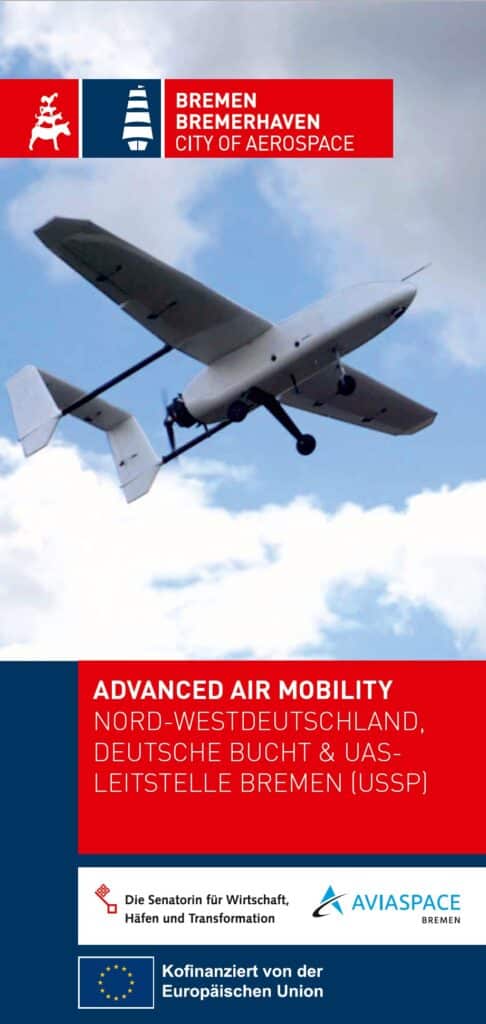
As part of the Bremen Bremerhaven City of Aerospace innovation cluster, the state of Bremen successfully supports companies and research institutions in the development and application of unmanned aerial systems (UAS). Expertise has been built up in the development and production of hardware and software systems, aircraft design, avionics, navigation and sensor technology. At the same time, the focus is on UAS applications to fulfill a wide range of tasks, such as carrying out sovereign tasks in the German Bight by using drones as carriers of sensor technology or setting up ground stations for UAS. By supporting the Advanced Air Mobility (AAM) Initiative Nordwestdeutschland and Deutsche Bucht & UAS-Leitstelle Bremen (USSP), the state of Bremen will continue to promote the further development of UAS activities by stakeholders based in the state in cooperation with Lower Saxony.
Bremen aerospace location
In the aerospace industry, more than 140 companies and 20 institutes with around 12,000 employees generate more than 4 billion euros per year. In terms of population, Bremen has the highest employment density in these sectors in Germany. Future-oriented jobs, especially for highly qualified people, characterize the aerospace industry and the aviation sector. Cutting-edge research in the state of Bremen provides sustainable support for industry in areas such as materials science and production technologies, space systems, remote sensing, bionics and robotics.
Advanced Air Mobility Initiative
Overall objective of the project
The aim of the initiative (AAM-NW) is the successive development of airspace structures within which the operation of UAS is considerably simplified and automated and safety is increased, taking into account all relevant airspace users. The aim is to gather experience for the creation of future highly automated operating strategies by linking and integrating UAS Traffic Management (UTM) into existing Air Traffic Management (ATM) systems.
The state of Bremen, with the focus on the UAS control center, and the state of Lower Saxony, with the focus on the flight areas and aeronautical infrastructures, are cooperatively involved here to support the joint upgrading of the airspace for Advanced Air Mobility.
Furthermore, the other northern German federal states (Mecklenburg-Western Pomerania, Hamburg and Schleswig-Holstein) will be integrated in an additive manner, i.e. the planned federal states will develop suitable structures in parallel in order to cooperate with AAM-NW at a later date.
Introduction
Advanced Air Mobility (AAM) is primarily understood to mean the integration of unmanned or autonomous aircraft into a shared airspace with manned aviation, which offers the possibility of "connecting both metropolitan and rural regions quickly, safely, sustainably and affordably, independently of existing ground-based transport infrastructures". However, smaller UAS are also suitable for performing certain monitoring and transportation tasks, particularly in rural regions.
The German Bight, its islands and neighboring coastal countries offer great potential for testing the operational processes of unmanned aviation with initially lower-risk missions and (smaller) aircraft out of sight and integrating them step by step into existing manned aviation. Particular attention must also be paid to shipping and nature conservation in the German Bight. A successively accumulated wealth of experience through regular UAS operation allows the continuous testing of operational arrangements through to the highly automated coordination of flight movements by a central control center and at the same time promotes confidence in this new technology. This is where the project comes in. Subsequently, the generated know-how will be transformed into areas and missions with higher risk, e.g. in urban areas, higher payloads and also people on board.
Time horizon and expansion stages
Common to all phases is the successive development of the corresponding BVLOS (beyond visual line of sight) flight areas. The focus here is on the use and illumination of the very low level airspace (VLL). For the respective expansion stages, coverage by the air situation picture is to be achieved and successively expanded. The corresponding visibility of manned general aviation, air rescue, authorities and organizations with security tasks (BOS) and UAS in BVLOS and VLOS (visual line of sight) operations must be mutually ensured, tested and verified. Especially as these activities require a test operation prior to real operation.
Phase 0 - 2023 Preliminary work of the initiative: Compilation and integration of all relevant airspace participants
Phase 1 - 2024: BVLOS areas Hatten - German Bight incl. trial operation (red map area)
Phase 2 - 2024-2025: BVLOS areas Cuxhaven & Helgoland incl. connection to phase 1 incl. trial operation (blue and green map area)
Phase 3 - 2026-2028: Expansion and connection of further airfields such as East Frisian Islands, Leck and Nordholz incl. trial operation (yellow map area) "From separation to integration"
Phase 4 - Vision 2030 Further development in the respective U-Space(s) set up towards a seamless link to the "U4" of the SESAR ATM master plan from 2035.
Bremen UAS control center (USSP)
Whether for industrial, university, government, security or civilian purposes: the use of
The number of drones will rise sharply in the coming years and will very likely even exceed the volume of manned air traffic. Coordination requires centralized bodies that can initiate collision avoidance and corresponding evasion procedures for unmanned aviation. The EU DVO 2021/664ff provides for a USSP (USSP = U-Space Service Provider), which provides aeronautical services (e.g. flight permits and activation) digitally for drone operators. To enable the AAM NW to contribute to the digital transformation of aviation in this sense, the establishment of a UAS control center (USSP) is planned from Bremen. This control center can protect manned aviation during urgently required missions in VLL airspace through real-time coordination and at the same time open up airspace utilization potential for unmanned aviation.
b.r.m. IT & Aerospace GmbH
The b.r.m. IT & Aerospace GmbH will be at the Aero in Friedrichshafen from April 9 - 11, 2025 at our joint stand of the State of Bremen in Hall B4 (Stand 312, Bremen). We will be showcasing our services for UAS, SORA, ConOps, VLOS and BVLOS operations. From the operational concept to approval, even complex tasks in unmanned aviation can be achieved.
Our team of aviation experts will take care of your specific Advanced Air Mobility application, no matter where you are in the development process. Our years of experience, starting with the development of a UAS and ending with Europe's most extensive ascent authorization over 3600 km², can give you the decisive time advantage to succeed in the emerging drone market.
We support you as a future U-Space Service Provider (USSP) in all areas of flight guidance and clearances. Benefit from our UTM Data Services, from weather services to electronic visualization and digital aerial imagery.
Hatten-UAS German Flight Center is the test center for unmanned aviation, located at the Oldenburg-Hatten EDWH airfield. Hatten-UAS can support companies, authorities and organizations with security tasks, universities and scientific institutions for projects and product developments for unmanned aircraft systems at any time. With 5500 m² of hangar space, licensed aircraft testers and an operating area that also allows mixed manned/unmanned operations, you get everything from a single source: from ground testing to customer presentations.
For your UAS operation the Flight School Borkum by providing qualified training for your remote pilots. As one of the first applicants for a "Light UAS Operator Certificate" (LUC), we support you in setting up a qualified flight operation.
Visit us at the AERO in Hall B4 (Stand 312, Bremen) and discuss with us how your future UAS applications can get off to a successful start.
For further information, please contact our management team led by Mr. Harald Rossol and Mr. Markus Rossol. You can reach us by phone at +49 421 34 14 94 and by e-mail at brm@brm.de.
We look forward to Aero 2025 and getting to know you.
Drone Days 2025
Can't make it to AERO? Then we'll see you at the Drone Days 2025
IT service, UAS, USSP. AAM, Green IT and the Oldenburg-Hatten airfield are another aspect of the transformation to digitalization with and through drones.
With the Bremen USSP UAS control center and the Hatten-UAS German Flight Center test center at Oldenburg-Hatten airfield (EDWH), we are looking forward to the future development of the industry, especially in the area of digital #airspace, #USSP and #BVLOS.
This initiative by the UAV umbrella is another important contribution to the Advanced Air Mobility Strategy.
We hope for further interest from the drone economy and look forward to discussing these and other topics on the future of aviation at AERO and AERO Drones 2025 (hall/booth no. B4-312)
You are currently viewing placeholder content from Turnstile. To access the actual content, click the button below. Please note that doing so will result in data being shared with third-party providers.
You are currently viewing a placeholder content from Facebook. To access the actual content, click the button below. Please note that doing so will share data with third-party providers.
You are currently viewing a placeholder content from Instagram. To access the actual content, click the button below. Please note that doing so will share data with third-party providers.
You are currently viewing a placeholder content from X. To access the actual content, click the button below. Please note that doing so will share data with third-party providers.