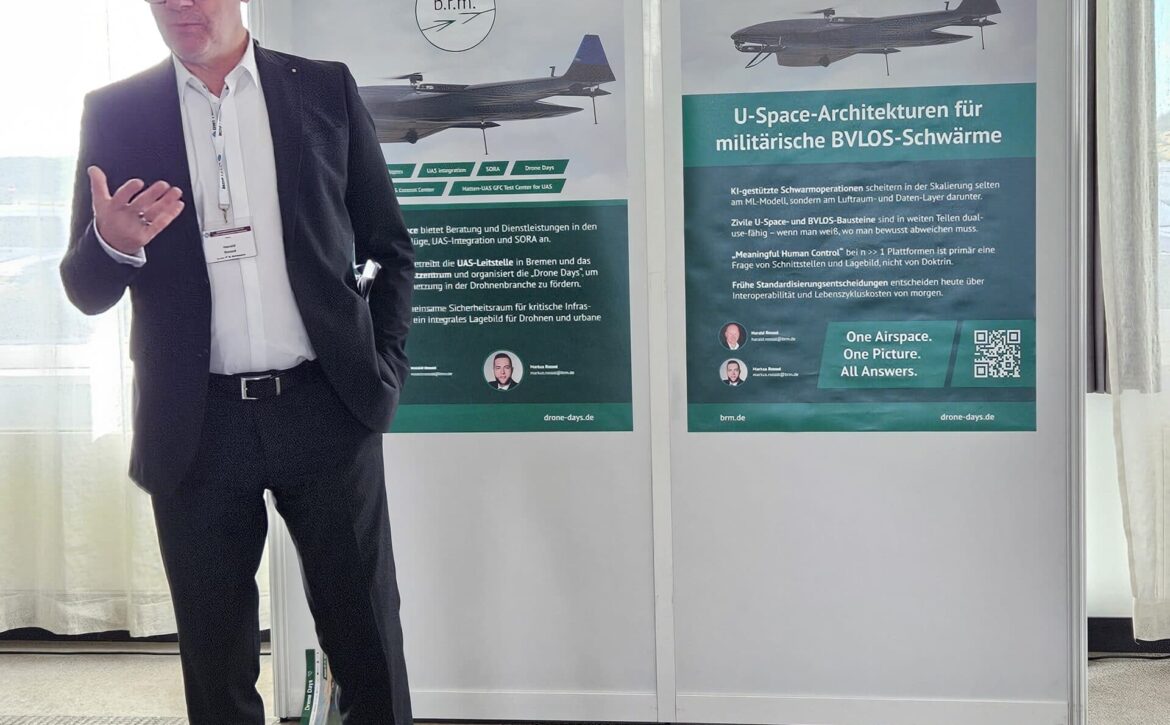
From September 21 to 23, the German Society for Defense Technology focused entirely on artificial intelligence and unmanned systems. Our CEO, Harald Rossol, delivered a clear message: The architecture for military BVLOS drone swarms already exists—in civilian applications.
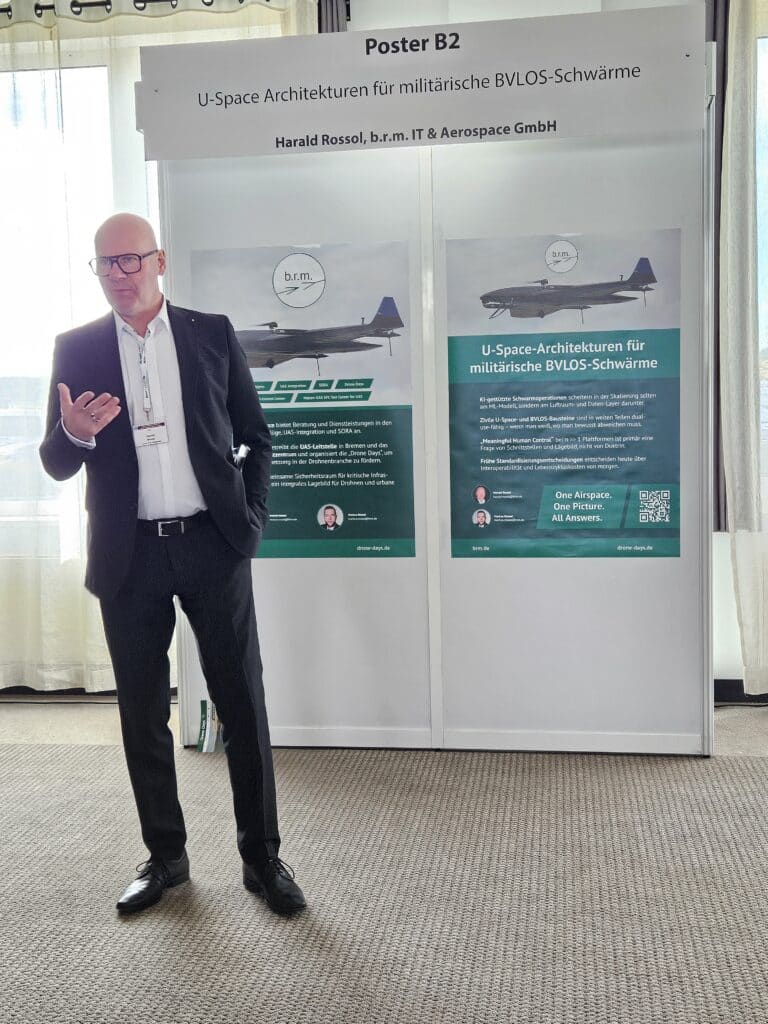
Unmanned systems are rapidly transforming the security and defense landscape. In particular, the use of drones beyond the pilot’s line of sight (BVLOS, Beyond Visual Line of Sight) and coordinated swarm flight place high demands on airspace management, data integration, and situational awareness. This was precisely the focus of the presentation “U-Space Architectures for Military BVLOS Swarms”—first as a short presentation in the plenary session, followed by four sessions at the poster station.
Four Principles for Scalable Swarm Operations
The discussion about AI in unmanned systems often centers on algorithms and machine learning models. Harald Rossol deliberately shifted the focus to the level below that and put forward four propositions for discussion:
Scaling rarely fails because of the model. When scaling up, AI-supported swarm operations typically do not reach the limits of the ML model, but rather those of the airspace and data layers on which they are based.
Civilian components are largely suitable for dual use. Many components from U-Space and BVLOS operations can also be used for military purposes. The key is to know exactly where one must consciously deviate from standard practice.
Meaningful human control is a matter of interfaces. When a person is responsible not for one but for many platforms at the same time, effective human control depends above all on good interfaces and a reliable situational picture—and less on doctrine.
Standardization today determines the costs of tomorrow. Early decisions about standards determine how interoperable systems will be later on and what their lifecycle costs will be.
Not a vision of the future, but a reality in practice
The second thesis was deliberately worded cautiously when it was submitted in the spring. After ten years of operational experience, the assessment today goes further: What is needed for military swarm operations does not have to be reinvented. The architecture already exists in the civilian sector and is in operation.
The foundation is provided by the Hatten-UAS German Flight Center at the Oldenburg-Hatten airfield, which is operated by b.r.m. BVLOS flights have been tested there since 2016; EUROCONTROL manages the site as a test and evaluation area—alongside the DLR. An airspace of approximately 3,600 square kilometers is available for unmanned aircraft systems, extending from the airfield out into the German Bight.
Another component is the Bremen UAS Control Center, which, as a prospective U-Space service provider, is currently in test operation. It provides U-Space services in accordance with EU Implementing Regulation 2021/664, the European legal framework for the safe integration of drones into airspace. This ensures that the infrastructure is compatible not only technically but also from a regulatory standpoint.
Light Field and Dark Field in the Digital Twin
The concept of a shared situational picture generated particular interest. Through data and sensor fusion in a digital twin, both the “known” and “unknown” areas become visible: not only cooperative aircraft that actively transmit their positions, but also non-cooperative objects that can be detected solely through sensors.
The point behind this is simple: Only those who know who is flying legally can identify those who are not. The “dark field” is not a new development here, but rather a follow-up question—existing sensor data can be incorporated into the digital twin via sensor fusion and compared against the “light field.”
What's Still Missing on the Military Front
Two factors distinguish civilian architecture from military applications.
First, ruggedized sensors and hardware. This is where specialized manufacturers excel—the purpose of an open architecture is to allow any ruggedized sensor to be integrated without having to rebuild the system.
Second, a certification framework for adaptive software. Civilian certification locks in the configuration: tested, approved, unchanged. In military applications, software updates are needed in the field. The digital twin carries this verification with it—the same code runs first in a simulation, then in a shadow environment against real telemetry, and finally on board. It isn’t rewritten, but rather executed in a different location.
One Airspace. One Picture. All Answers.
Harald Rossol summarized his presentation in a guiding principle: One Airspace. One Picture. All Answers. A shared airspace, a unified situational picture—and thus the answers that operators, authorities, and the armed forces alike need.
The DWT conference demonstrated just how great the interest is in solutions that have been proven in practice. We are pleased with the many discussions that took place at the event and look forward to continuing our dialogue with partners from the Bundeswehr, industry, and research—for example, at our Drone Days.
About b.r.m. IT & Aerospace
b.r.m. IT & Aerospace offers consulting and services related to BVLOS flights, UAS integration, and SORA. The company operates the Bremen UAS Control Center and the Hatten UAS German Flight Center, and organizes Drone Days to promote innovation and networking in the drone industry.
b.r.m. IT & Aerospace GmbH
Harald Rossol
harald.rossol@brm.de
+49 421 341494