Since December 31, 2020, every operator of a UAS weighing more than 250g is obliged to register. This also includes UAS under 250g that are equipped with cameras or other sensors to capture personal data. Several identifiers (ID) are listed in the EU drone regulations. The most important include the e-ID, the remote pilot ID and the remote ID. These are distinguished from each other by their meanings.
e-ID
There is a prescribed format for the e-ID within the EU, which consists of many individual components. The registration number is now explained using the example "DEU123456abc7-xyz-". "DEU" stands for the country of registration, in this case Germany. The following digits of the e-ID are randomly generated. The "7" in this case is a control digit, which is calculated using the PIN "xyz". The PIN should be kept secret so that it cannot be used by unauthorized persons. This e-ID must be attached to the drone. It therefore identifies the legal owner and operator of the drone. This number can be attached to several drones.
Remote Pilot ID and Remote ID
The remote pilot ID (RP-ID) is part of the operator ID and is a number on the EU certificate of competence for remote pilots. It is the personal identification number for remote pilots, which must be carried during operations. The remote pilot ID is issued by the Federal Aviation Office after the request and registration. The remote pilot ID certifies the pilot himself and is therefore not required by law to be attached to the drone. However, this ID should not be confused with the remote ID. The remote ID identifies the drone as an approved UAS for the A2 subcategory of the "Open" class, i.e. the EU remote pilot certificate. The Remote ID must be affixed to the drone.
The Federal Aviation Office has created a FAQ for further questions. In it you will find answers to frequently asked questions. You can find exclusive content from events and much more on our Instagram account.
As a UAS operator (Unmanned Aircraft Systems operator) in Germany, you are required to have special insurance for your own drone. It is important to note that conventional private liability insurance does not usually cover any damage to the drone.
The first question is whether the drone to be insured is to be used privately or (also) commercially. In the case of commercial use, for example by our UAS consultant Markus Rossol, we recommend a combined insurance policy that covers both commercial and private use of the drones.
Compulsory insurance applies to all drones, multicopters and model aircraft. Drone insurance policies are available from around €15 per year, but in addition to the price, you should also consider the following factors.
Drone insurance
The contract term
The contract terms of the various insurance models vary greatly. Most insurance policies are very flexible and the minimum contract term is often only 12 months. There are also offers with no minimum term at all, with monthly or even daily termination options.
The sum insured
Insurance policies with cover sums from 1.5 million euros are common. Larger sums of 20 to 50 million euros are also often offered. These models are usually linked to private liability insurance so that larger claims, such as personal injury, are also covered.
Amount of the deductible
The deductible refers to the personal contribution to be made to the claim amount in the event that the insurance has to be claimed. When choosing insurance, it should be noted that the amount of the excess is partly predetermined and partly freely selectable. There are also insurance policies with no excess at all. The principle usually applies here: the higher the excess, the lower the premium.
The geographical scope
Especially if you want to travel with your drone - whether privately or, like us, to trade fairs such as the AERO 2023 last week - you should definitely pay attention to the geographical scope of the drone insurance. Here, the offers differ in insurances with the scope of application Germany, Europe-wide or worldwide (sometimes with exceptions such as "worldwide without US territories"). An insurance policy with a worldwide geographical scope does not necessarily have to be more expensive than a policy that is only valid in Germany.
The area of application
As previously mentioned, it is important to consider whether the drone is only to be used privately or also commercially. If the drone insurance is linked to the private liability insurance, this usually excludes commercial use of the UAS. One way to cover commercial and private use in one insurance policy is to take out combined cover. Here, both usage scenarios are insured and it is also possible to book certain additional services.
The number of copters
Regardless of the area of application, it is important to decide how many copters are to be insured. If only your own drone is to be insured, this is usually noted with the serial number in the insurance policy. It is also possible to cover the flying of third-party drones in addition to your own drone. Please also note that a drone driver's license is required for flying common UAS with a take-off weight of 250 g or more. Since January 2021, you have been able to obtain the small drone license online from the German Federal Aviation Office (LBA). Here you will take part in an online training course followed by an exam to ensure that you have the basic knowledge required to fly a drone safely.
Number of insured taxpayers
The number of insured pilots determines whether and, if so, who other than you may pilot the insured drone. The various insurance models differentiate here between your own person, your own person and family members or your own person, family members, friends and strangers. In addition to insuring your own drone, labeling it is also mandatory in Germany. Self-adhesive aluminum stickers engraved with the eID and the EU drone registration number are best suited for this purpose. In the event of damage, for example, the EU drone registration number can be used to determine who owns the drone and how it is insured. Registration is required to obtain the eID (or UAS operator number). In Germany, you can register online to obtain your eID. Among other things, you will need to provide your drone insurance number.
Summary
Drone insurance is offered by numerous insurance companies. Some of these include Allianz, HUK Coburg, R+V Versicherung, Generali, ADAC and AXA. Regardless of whether you want to fly your own or someone else's UAS privately or commercially in Germany, you need appropriate drone liability insurance. The numerous insurance companies also offer numerous insurance models that cover a wide variety of usage scenarios. So decide in advance exactly where you want to fly your drone, who is allowed to control your drone and how high the sum insured including your excess should be in the event of a claim.
Bremen-based IT service provider develops solutions for integrating UAS into the existing airspace structure
U-Space Reallabor North-West Germany and German Bight - UAS Control Center Bremen (USSP)
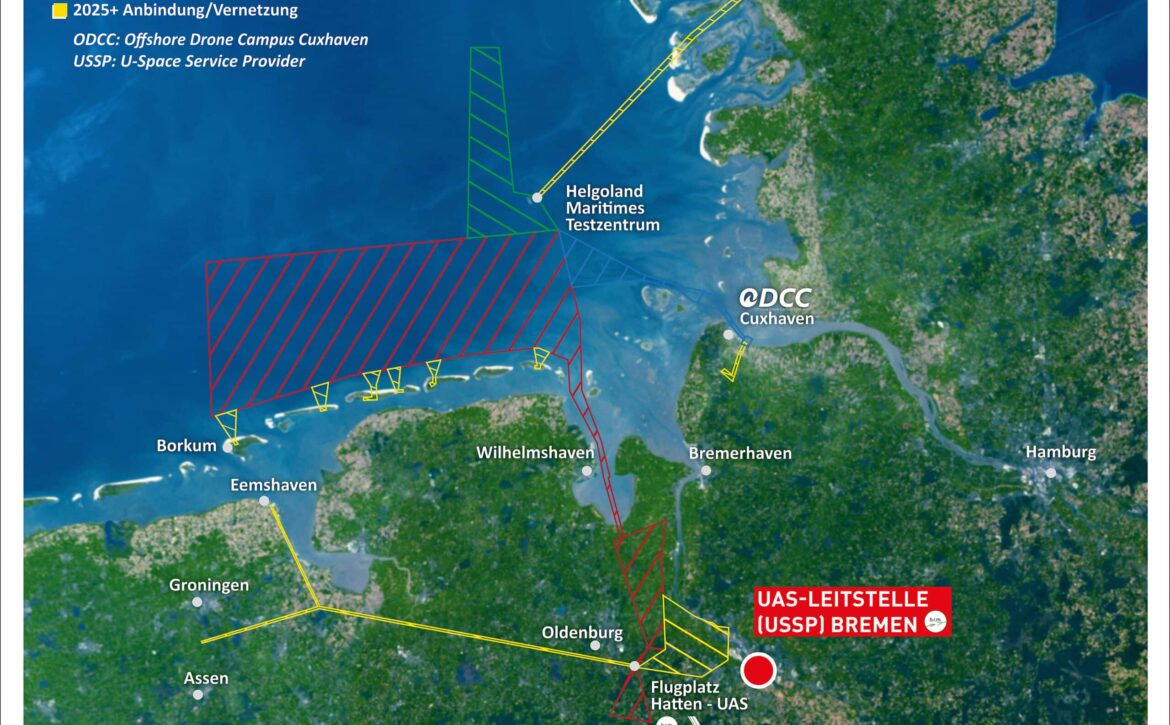
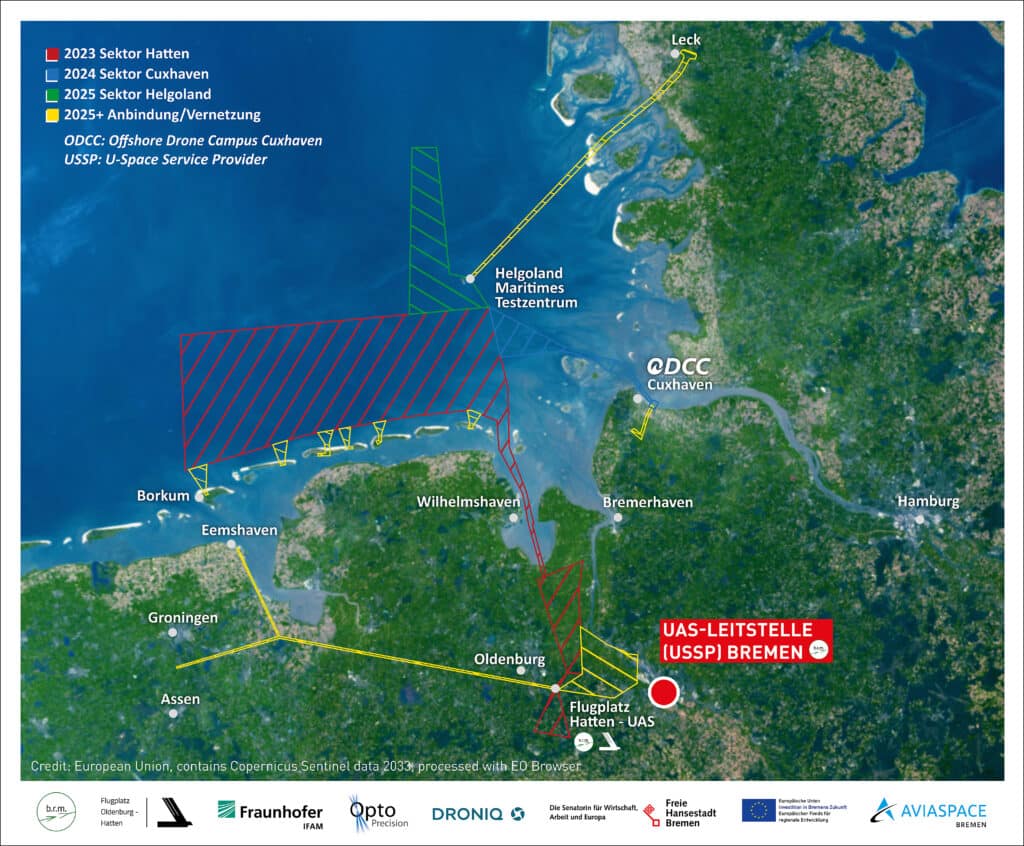
Bremen, 14.04.2023: b.r.m. IT & Aerospace will present the ideas for the project platform "U-Space Reallabor Nord-Westdeutschland und Deutsche Bucht - UAS-Leitstelle Bremen (USSP)" together with its partners at the "Bremen City of Aerospace" state stand at AERO 2023 in Friedrichshafen from April 19 to 22.
The first stage of the U-Space Real-World Laboratory North-West Germany and German Bight will cover a corridor from the mainland across the Jade Bay into the German Bight. It will be used to research and develop systems for the safe interaction of UAS (Unmanned Aircraft Systems) and manned aircraft under VFR, IFR and night VFR conditions.
As part of the development process, b.r.m. IT & Aerospace is working closely with Bremen's Fraunhofer Institute for Manufacturing Technology and Applied Materials Research (IFAM). The Bremen-based IT service provider is developing an intelligent IT infrastructure for the safe interaction of drones and manned aircraft, which will support the development of the rapidly prospering drone market.
To this end, b.r.m. IT & Aerospace is planning to set up the Bremen UAS Control Center (USSP). As a certified USSP (U-Space Service Provider), the company will be able to offer its customers all the necessary IT information services for the operation of drones from there.
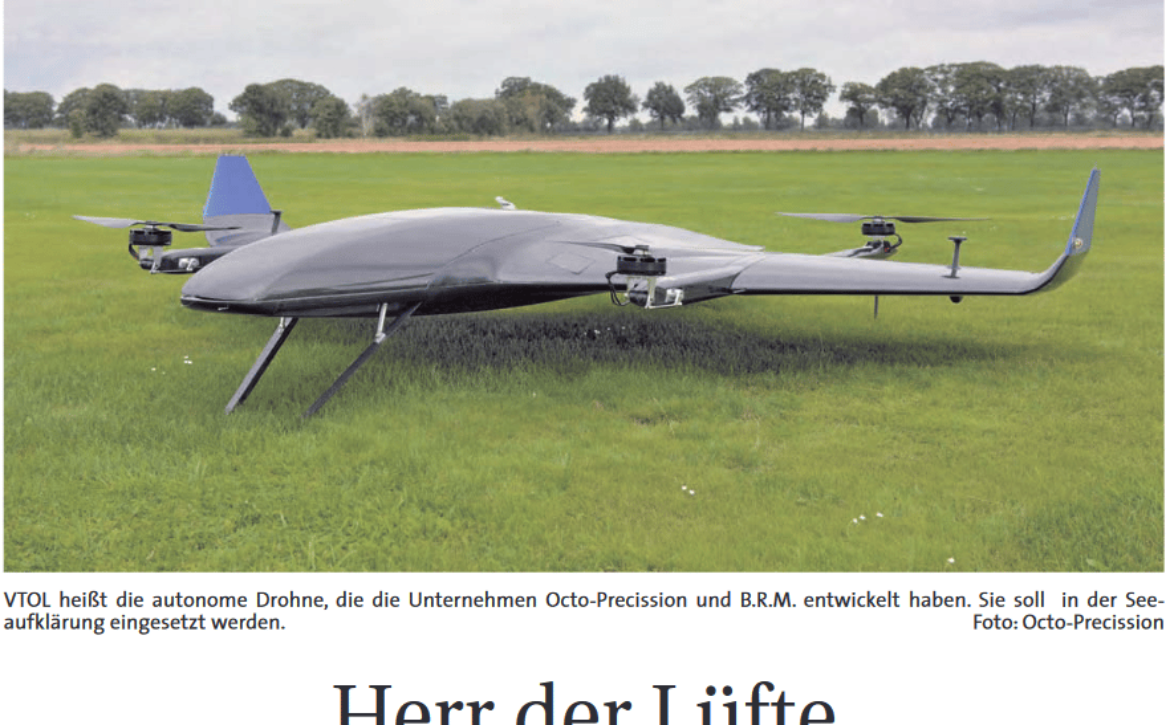
"At its core, the safe integration of drones into air traffic is a question of digitalization," says Markus Rossol, Managing Partner of b.r.m. IT & Aerospace. "Our company has already taken significant steps in the development of a sustainable USSP data center. Last year, we were able to gain important insights as part of the VTOL-EGM environmental monitoring project supported by the European Regional Development Fund together with OptoPrecision GmbH."
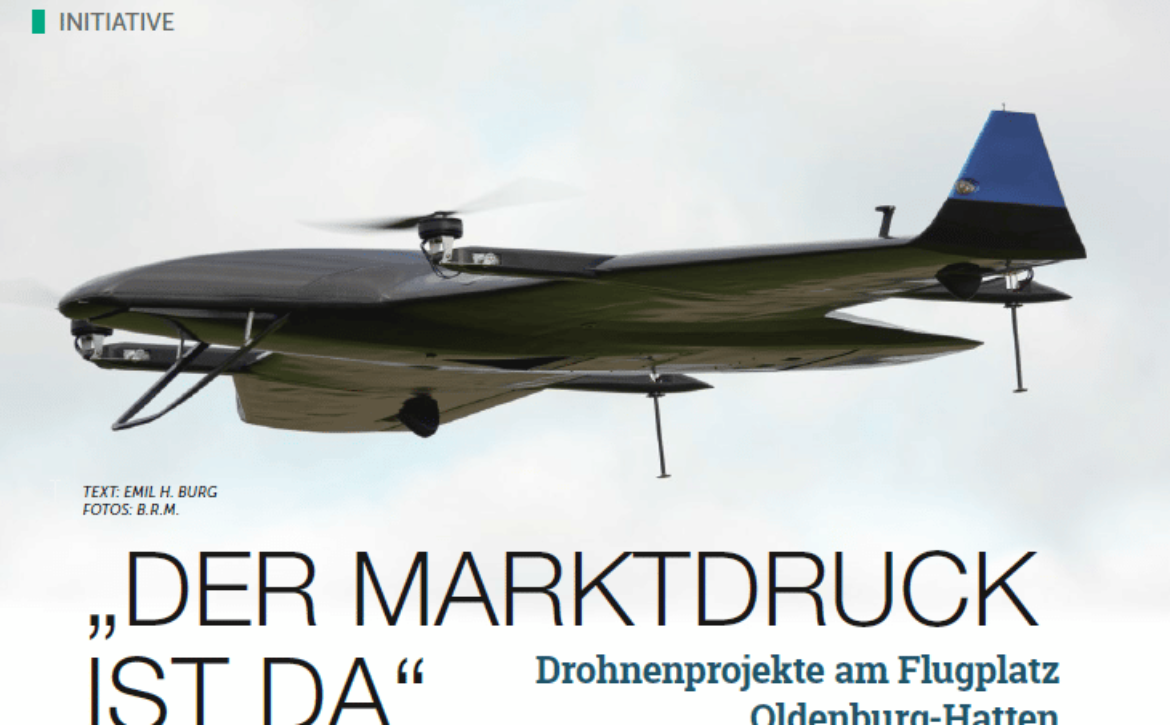
The missions with the Optoprecision VT-4 "Rochen" drone with a range of up to 600 km started at the new Hatten-UAS drone test center at the Oldenburg-Hatten airfield (EDWH). Among other things, BVLOS (Beyond Visual Line of Sight) flights were also carried out.
Visit us at the AERO 2023 and you will find us at the joint stand of the State of Bremen in Hall A2/216.
At the 61st general meeting of UAV DACH e.V., the association was restructured. The new basic program was also adopted.
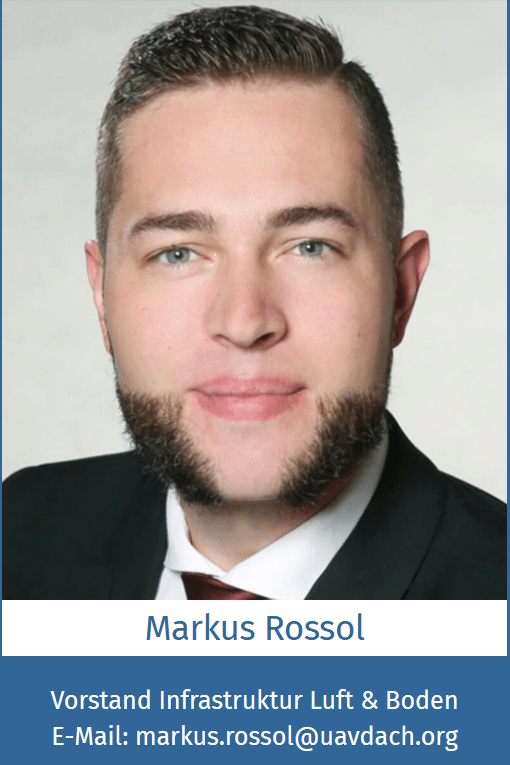
The board of the association for unmanned aviation "UAV DACH e.V." was newly elected. Markus Rossol was elected to the new, broader-based board of the association as the board member responsible for Air & Ground Infrastructure. He thanks the members of the association for the trust they have placed in him and looks forward to a cooperative collaboration. Special thanks also go to the outgoing members of the Board, whose successful association work has accompanied UAV DACH e.V. to date.
Furthermore, the new basic program "inform, network and shape" now comes into force. This was previously adopted at the 60th General Assembly in November 2022. Further information can be found on the UAV DACH e.V. website. There are also new posts on our Instagram account.
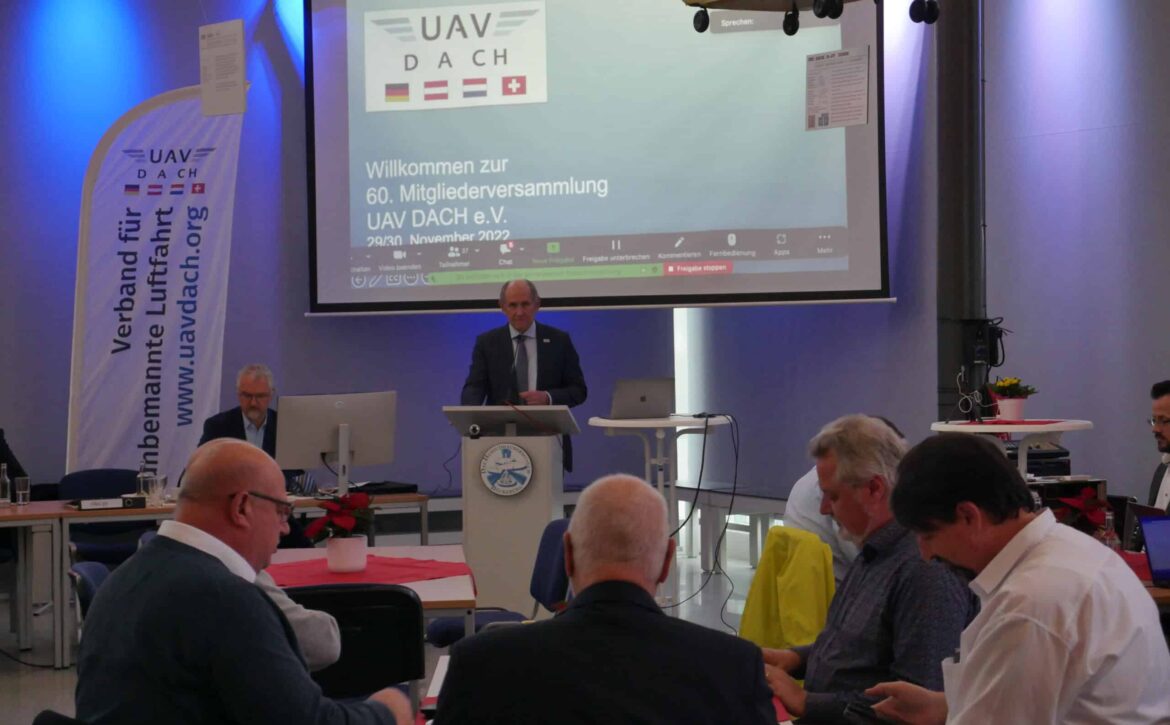
The association's annual general meeting at the Bückeburg Helicopter Museum Source: UAV DACH e.V. / Jan Schönberg
Last Tuesday and Wednesday (November 29 and 30, 2022), the 60th Annual General Meeting of the UAV DACH e.V. - Association for Unmanned Aviation took place. The UAV DACH e.V. office had invited guests to the German Helicopter Center in Bückeburg. In addition to the extensive agenda items, there was of course plenty of time to talk about the drone economy and meet new and old faces.
Specialist groups and close cooperation with the authorities
The chairman of the association, Mr. Achim Friedl, led those present in the hall and those connected online through the extensive agenda. The addition of 18 new members brings the association to a total of 256 members from the various sectors of unmanned and manned aviation. Particular emphasis was placed on the work of the UAV Dach e.V. specialist group, which was carried out in closer cooperation with the various authorities.
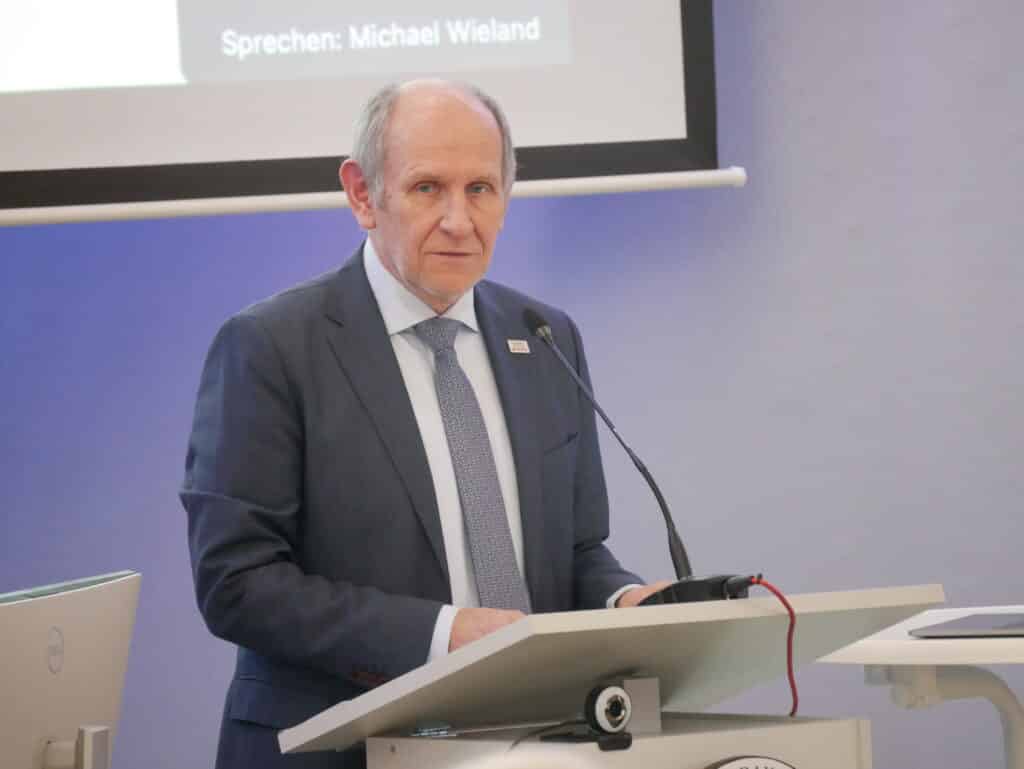
The Chairman of the Board, Mr. Achim Friedl, guided the members through the conference Source: UAV DACH e.V. / Jan Schönberg
AG Zukunft - New concept presented and adopted at the general meeting
In order to put the association on a solid footing for the future, the Future Working Group drew up a comprehensive concept. This was presented in detail on Tuesday and highlighted the association's good features and those in need of improvement. A number of resolutions were derived from this, such as the expansion of the Executive Board and a more division-specific structure. The members voted in favor of this future concept by a large majority, and the first part is already being implemented.
New interim Management Board
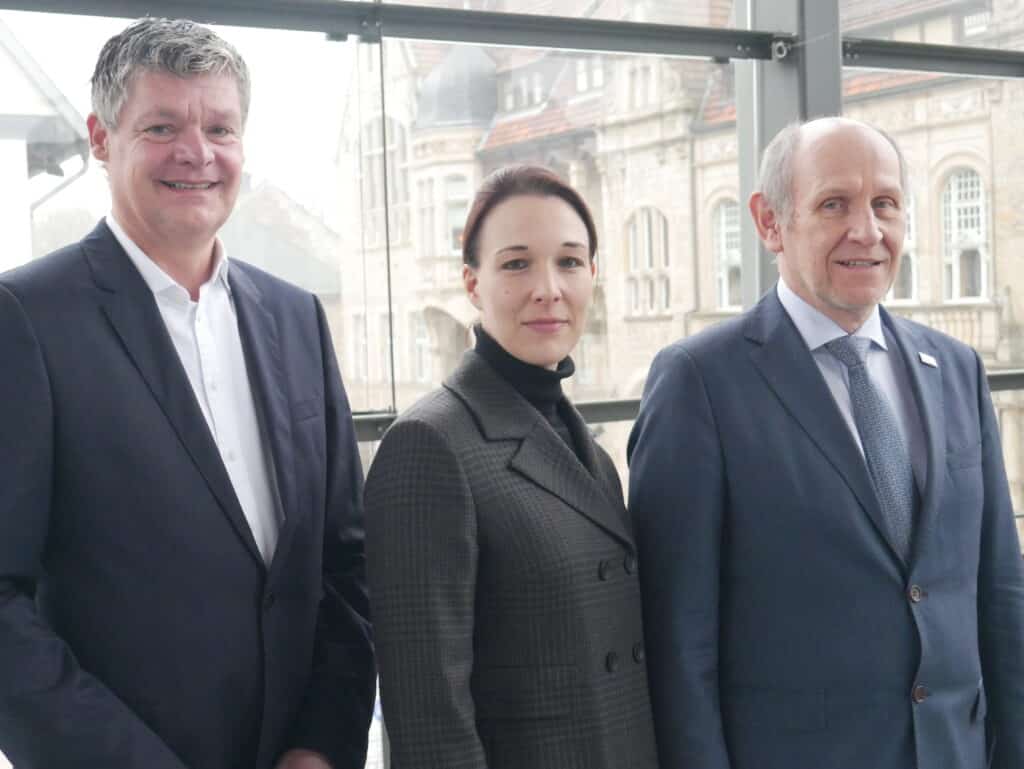
The new Board of UAV Dach will also be elected until the next Annual General Meeting in the new year, and an interim Board has been appointed to bridge this period. Mr. Achim Friedl, Ms. Sabrina John and Dr. Gerald Wissel were elected as interim board members at the general meeting to continue the business until the new board is elected.
Interim board of UAV DACH e.V. (from left: Dr. Gerald Wissel, Ms. Sabrina John, Mr. Achim Friedl) Source: UAV DACH e.V. / Jan Schönberg
Aircraft radio was introduced for communication in aviation. This was divided into different classes, including BZF I and BZF II.
What BZF is
The restricted radiotelephony certificate is a radiotelephony certificate for the flight service. There are different classes of this certificate with different authorizations. The first class (BZF I) entitles the holder to use radiotelephony in German and English in accordance with visual flight rules.
There is also the BZF II, which allows radiotelephony within Germany in German according to the visual flight rules.
You can find detailed descriptions of other classes of aircraft radio certificates on the website of the Federal Network Agency.
Why this is relevant for drones
As the BZF I and BFZ II are valid for visual flight, unmanned flying objects, i.e. UAV and UAS, are also included. For users of the VLOS, EVLOS and BVLOS operating modes, the aeronautical radio certificate is not uninteresting, as communication with the USSP will be mandatory from January 2023 as part of the new regulation.
The flight radio certificate is therefore also important for the USSP, as it must communicate with the pilots to ensure the safety of the drones.
The UAS team at b.r.m. IT & Aerospace has many qualifications and awards. The IT and UAS consultant Markus Rossol is in possession of the BZF I certificate. The license for the restricted radiotelephony certificate I for the aeronautical radio service is issued by the Federal Network Agency for Electricity, Gas, Telecommunications, Post and Railway.
The USSP b.r.m. and U-Space Norddeutschland are featured in the January issue of the trade magazine Drones to coincide with the entry into force of the EU Implementing Regulation on U-Space. The market pressure is there. Read the exclusive article here in advance:
This article was published in issue 1/2023 of the trade journal Drones, the magazine for the drone economy. This and all other available issues are available in the magazine store at https://www.alles-rund-ums-hobby.de/drones/ .
As part of the 7th North German Aviation Forum, the Weser Report interviewed Mr. Harald Rossol and Mr. Markus Rossol from b.r.m.. You can read the article on the Weser Report website or here in our blog.
Various flight zones have been introduced to make flights clearer and safer. These include a TRA and a TMZ, which must be observed by the pilot.
TRA - limited in time
A temporary restricted area (TRA) is a flight area that is temporarily restricted. Air traffic is temporarily or permanently restricted in this airspace. This is intended to prevent threats to public safety or order. A TRA is often located near military training areas.
Clearance to fly over is then issued by NOTAM. A NOTAM can also change the vertical extent of the flight restriction area.
TMZ - more transparency for more security
A transponder mandatory zone (TMZ) is a mandatory transponder zone. The use of a transponder is therefore mandatory in this area. A TMZ is usually located near regional airports, as it protects civil air traffic. A TMZ is visible on the pilot's ICAO chart and also indicates the frequencies in which the pilot must remain.
The clearance of this airspace is not required by air traffic control during the day, as this is controlled airspace E.
Basic training pilot license
Both flight zones are part of air traffic control and the basic training of a pilot. You learn about the TMZ and the TRA during training for a private pilot license (PPL). Flugschule Borkum GmbH offers such training at the Oldenburg-Hatten EDWH airfield, among others.
Harald Rossol, the founder and managing director of b.r.m. IT & Aerospace, is developing methods and approaches for the use of drones in air traffic. Under the term "U-Space", possibilities and opportunities for the use of drones are to be developed and implemented. The Oldenburg-Hatten airfield (EDWH) served as a representative location for a get-together with AVIASPACE Bremen e.V. and other industry experts.
You are currently seeing a placeholder content of YouTube. To access the actual content, click on the button below. Please note that data will be passed on to third-party providers.
You are currently viewing placeholder content from Turnstile. To access the actual content, click the button below. Please note that doing so will result in data being shared with third-party providers.
You are currently viewing a placeholder content from Facebook. To access the actual content, click the button below. Please note that doing so will share data with third-party providers.
You are currently viewing a placeholder content from Instagram. To access the actual content, click the button below. Please note that doing so will share data with third-party providers.
You are currently viewing a placeholder content from X. To access the actual content, click the button below. Please note that doing so will share data with third-party providers.