AERO and AERO Drones 2024
It starts in 5 days and we are looking forward to it!
b.r.m. IT & Aerospace will be exhibiting together with partners at the joint stand of the State of Bremen in Hall 2, Stand 309.
We look forward to your visit. Harald Rossol and Markus Rossol are waiting for you.
Partner on the Bremen state stand
AIRBUS Defense & Space
T +49 421 539 4562 | www.airbus.com
AVIASPAC E BREMEN
T +49 421 2208275 | www.aviaspace-bremen.de
Cast Coil
T +49 176 8789707 | www.castcoil.de
DRO NIQ
T +49 69 509547 400 | www.droniq.de
Oldenburg-Hatten airfield
T +49 4481 927976 | www.edwh.de
Fraunhofer IFAM
T +49 421 2246-0 | odcc.ifam.fraunhofer.de
Hanseatic Aviation Solutions
T +49 421 59679420 | www.hanseatic-avs.de
Lufthansa Industry Solutions AS
T +49 40 5070 30000 | www.lhind.dlh.de
Aviation Authority State of Bremen
T +49 421 36197590 | www.haefen.bremen.de/luftfahrt
OptoPrecision
T +49 421 9496110 | www.optoprecision.de
Sigma Aerospace Metals
T +49 421 69 4134-20 | www.sigmaaero.de
UNMANNED AVIATION FROM BREMEN
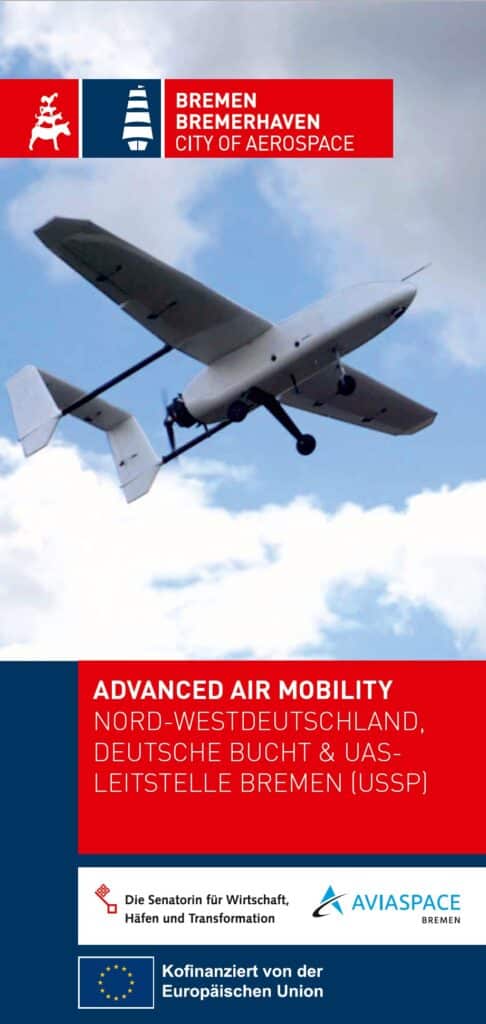
As part of the Bremen Bremerhaven City of Aerospace innovation cluster, the state of Bremen successfully supports companies and research institutions in the development and application of unmanned aerial systems (UAS). Expertise has been built up in the development and production of hardware and software systems, aircraft design, avionics, navigation and sensor technology. At the same time, the focus is on applications of UAS for the fulfillment of a wide range of tasks, such as the execution of sovereign tasks in the German
Bay through the use of drones as carriers of sensor technology or the establishment of ground stations for UAS. With the support of the Advanced Air Mobility (AAM) Initiative Nordwestdeutschland and Deutsche Bucht & UAS-Leitstelle Bremen (USSP), the state of Bremen will promote the further development of the UAS activities of the stakeholders based in the state in collaboration with
Lower Saxony further.
BREMEN
AEROSPACE LOCATION
In the aerospace industry, more than 140 companies and 20 institutes with around 12,000 employees generate more than 4 billion euros per year. In terms of population, Bremen has the highest employment density in these sectors in Germany. Future-oriented jobs, especially for highly qualified people, characterize the aerospace industry
and the aviation sector. Cutting-edge research in the state of Bremen provides sustainable support for industry in areas such as materials science and production technologies, space systems, remote sensing, bionics and robotics.
ADVANCED AIR MOBILITY INITIATIVE
OVERALL OBJECTIVE OF THE PROJECT
The aim of the initiative (AAM-NW) is the successive development of airspace structures within which the operation of UAS is considerably simplified and automated and safety is increased, taking into account all relevant airspace users. The aim is to gather experience for the creation of future highly automated operating strategies by linking and integrating UAS Traffic Management (UTM) into existing Air Traffic Management (ATM) systems.
The state of Bremen, with the focus on the UAS control center, and the state of Lower Saxony, with the focus on the flight areas and aeronautical infrastructures, are cooperatively involved here to support the joint upgrading of the airspace for Advanced Air Mobility.
The main players in this project are: Aviaspace Bremen e.V., b.r.m. IT & Aerospace GmbH, Droniq GmbH, Flugplatz Oldenburg-Hatten GmbH, Flugschule Borkum GmbH, Fraunhofer IFAM, Offshore-Drone-Campus-Cuxhaven (ODCC), Optoprecision GmbH.
In addition, the group of affected stakeholders now comprises over 200 players who are involved in the overall project in various ways.
Furthermore, the other northern German federal states (Mecklenburg-Western Pomerania, Hamburg and Schleswig-Holstein) will be integrated in an additive manner, i.e. the planned federal states will develop suitable structures in parallel in order to cooperate with AAM-NW at a later date.
INTRODUCTION
Advanced Air Mobility (AAM) is primarily understood to mean the integration of unmanned or autonomous aircraft into a common airspace with manned aviation, which offers the possibility of "connecting both metropolitan and rural regions quickly, safely, sustainably and affordably, independently of existing ground-based transport infrastructures".1 However, smaller UAS2 are also suitable for taking on certain monitoring and transport tasks, particularly in rural regions.
The German Bight, its islands and neighboring coastal countries offer great potential for testing the operational processes of unmanned aviation with initially lower-risk missions and (smaller) aircraft out of sight and integrating them step by step into existing manned aviation. Particular attention must also be paid to shipping and nature conservation in the German Bight.
A successively accumulated wealth of experience through regular UAS operation allows the continuous testing of operational arrangements up to the highly automated coordination of flight movements by a central control center and at the same time promotes confidence in this new technology. This is where the project comes in. Subsequently, the generated know-how will be transformed into areas and missions with higher risk, e.g. in urban areas, higher payloads and also people on board.
TIME HORIZON AND EXPANSION STAGES
Common to all phases is the successive development of the corresponding BVLOS (beyond visual line of sight) flight areas. The focus here is on the use and illumination of the very low level airspace (VLL). For the respective expansion stages, coverage by the air situation picture is to be achieved and successively expanded. The corresponding visibility of manned general aviation, air rescue, authorities and organizations with security tasks (BOS) and UAS in BVLOS and VLOS (visual line of sight) operations must be mutually ensured, tested and verified. Especially as these activities require a test operation prior to real operation.
Phase 0 - 2023 Preliminary work of the initiative: Compilation and integration of all relevant airspace participants
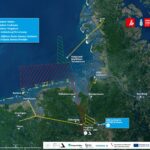
Phase 1 - 2024: BVLOS areas Hatten - German Bight incl. trial operation (red map area)
Phase 2 - 2024-2025: BVLOS areas Cuxhaven & Helgoland incl. connection to phase 1 incl. trial operation (blue and green map area)
Phase 3 - 2026-2028: Expansion and connection of further airfields such as East Frisian Islands, Leck and Nordholz incl. trial operation (yellow map area) "From separation to integration"
Phase 4 - Vision 2030 Further development in the respective built-up U-Space(s) towards a seamless connection to the "U4" of the SESAR ATM master plan from 2035 onwards
UAS CONTROL CENTER BREMEN (USSP)
Whether for industrial, university, government, security or civilian purposes: the use of
The number of drones will rise sharply in the coming years and will very likely even exceed the volume of manned air traffic. Coordination requires centralized bodies that can initiate collision avoidance and corresponding evasion procedures for unmanned aviation. The EU DVO 2021/664ff provides for a USSP (USSP = U-Space Service Provider), which provides aeronautical services (e.g. flight permits and activation) digitally for drone operators. To enable the AAM NW to contribute to the digital transformation of aviation in this sense, the establishment of a UAS control center (USSP) is planned from Bremen. This control center can protect manned aviation during urgently required missions in VLL airspace through real-time coordination and at the same time open up airspace utilization potential for unmanned aviation.